
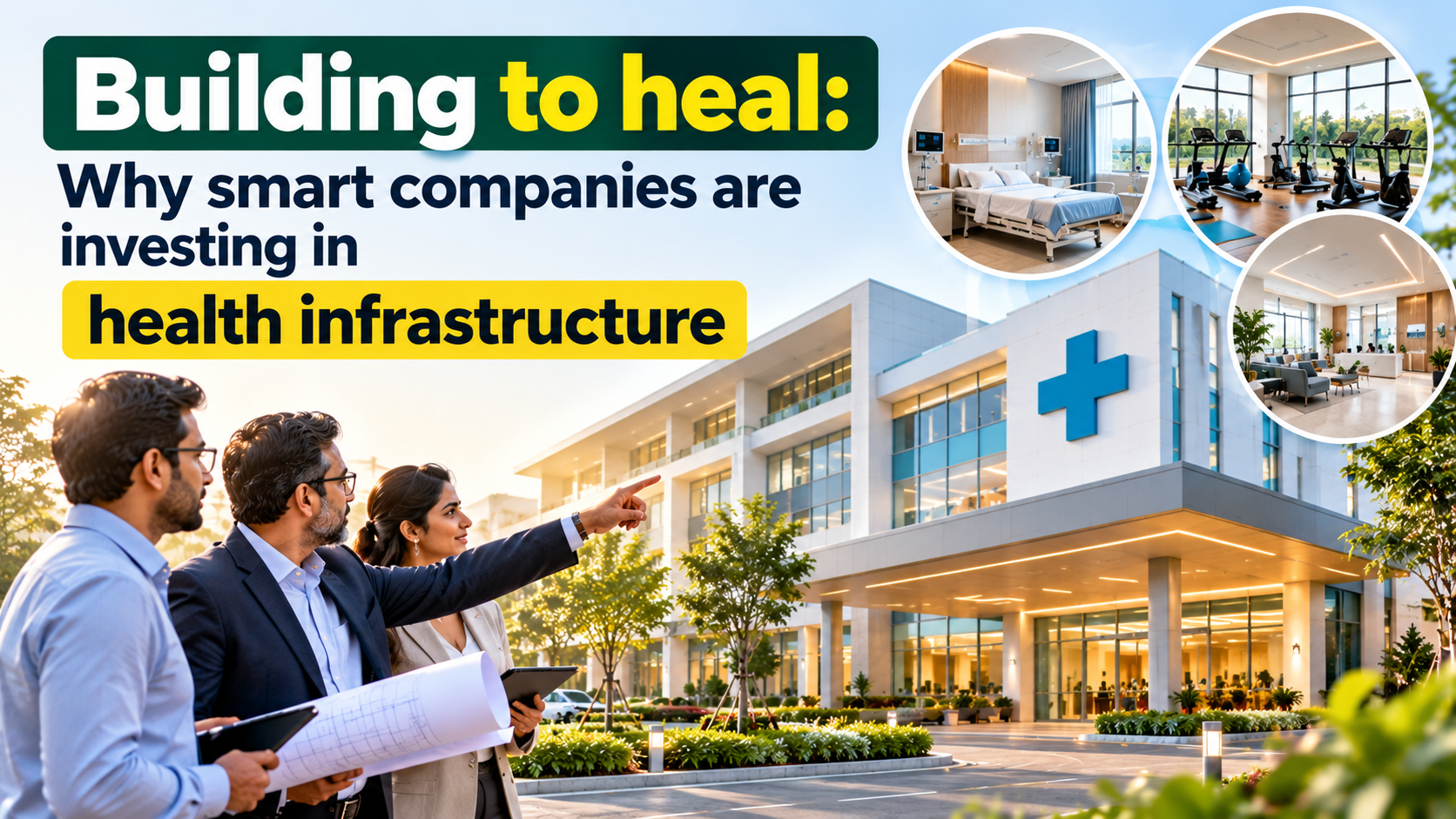
Hospitals, medical colleges and rural clinics built by corporates can outlast the companies themselves. That is precisely why the shrewdest firms are making them a strategic priority. Companies who have a vision and leadership that can see lasting growth, do not cite policies on why it cannot be done, rather their own conversations move on how it can be done.
From CSR cheques to lasting institutions
For much of the past decade, corporate India's engagement with healthcare followed a familiar script. A company would fund a health camp, donate an ambulance or sponsor a ward, issue a press note, and move on to the next financial year's CSR allocation. The intent was sincere and the work often useful. But a great deal of it left little behind once the cheque had been cleared.
That approach is changing, and for good reason. A growing number of companies, from large conglomerates to mid-sized manufacturers, are asking a more demanding question: what can we build that will still be serving people thirty or fifty years from now? Increasingly, the answer is health infrastructure. A well-run hospital, Community health center, senior citizens residences, palliative units, a nursing school or a network of primary health centres is not a one-time gesture. It is an institution, and institutions, unlike campaigns, endure.
The business case
The business case is more straightforward than it first appears. Every enterprise ultimately depends on people: the workers on its shop floor, their families, the farmers and small suppliers in its value chain, and the customers in the towns where it operates. When these communities lack access to dependable healthcare, the costs surface quietly but persistently. Absenteeism rises, productivity dips, attrition climbs and skilled professionals hesitate to relocate to industrial belts where a serious illness means a long journey to the nearest city.
A quality hospital near a manufacturing cluster, or a string of clinics in the villages that supply a company's raw material, addresses these risks at the root. Employees recover faster and return to work sooner. Families are healthier, and children stay in school. Talent becomes easier to attract and retain. Viewed this way, health infrastructure is not an act of charity sitting outside the balance sheet. It is part of the foundation on which productivity and long-term growth rest.
A legacy that outlives its founders
Then there is the matter of legacy. India's own history offers ample evidence of what patient, purposeful investment in health can achieve. Several of the country's most respected hospitals, cancer centres and medical colleges began as the vision of an industrial family or a business founder who wished to give something lasting back to society. Decades on, these institutions continue to train doctors, treat lakhs of patients every year and carry their founders' names with quiet dignity. No advertising budget can purchase that kind of goodwill. It is earned slowly, by building something that keeps improving lives long after the original investment has been made.
Built to sustain itself
Legacy, however, is only possible if the institution can sustain itself. This is where the more thoughtful companies distinguish themselves. They plan for decades of operation, not merely for construction. Who will staff the facility once it opens? How will it be funded after the initial grant is spent? How will it grow as the needs of the community change?
The answers vary, but certain models have proven their worth. Tiered pricing allows patients who can pay to cross-subsidise care for those who cannot. Empanelment under government schemes such as Ayushman Bharat brings in steady revenue while widening access. Endowment funds provide a dependable income stream. Energy-efficient buildings, rooftop solar and water recycling bring down running costs and the environmental footprint alike. Telemedicine links allow a modest rural clinic to draw on specialists in a city hospital, stretching every rupee further. Sustainability, in this sense, is both financial and environmental, and the best projects take both seriously from the first day.
The dividend of trust
There is also a dividend in trust. Investors now weigh environmental, social and governance performance closely, and a functioning hospital speaks far more convincingly on the social front than any sustainability report. Employees take pride in working for an organisation that makes a visible difference. State governments and local administrations tend to regard such companies as partners in development rather than as outsiders. Over time, this reservoir of goodwill becomes a durable competitive advantage.
Getting it right
None of this happens by accident. The companies that get it right begin by studying the real health needs of a region, its disease burden and its gaps in services, rather than choosing projects for their visibility. They partner with experienced hospital operators, medical institutions, non-profits and state health departments instead of attempting everything alone. They invest as much in people as in buildings, training nurses, technicians and community health workers whose skills multiply the impact of every facility. They measure outcomes honestly and report them transparently. And they chart a clear path towards self-sufficiency or a responsible handover.
The choice before corporate India
India's healthcare needs are vast, and no government, however committed, can meet them single-handedly. Corporate India has the capital, the managerial capability and, increasingly, the will to help close the gap. The question is whether it will do so through scattered gestures or through institutions built to last.
The smartest companies have already made their choice. They understand that a firm's true legacy is measured not only in quarterly results but in the lives its decisions touch. A hospital that heals, a clinic that reaches a remote village, a college that trains the next generation of caregivers: these are investments that keep paying back, long after the balance sheets of today have been forgotten.