
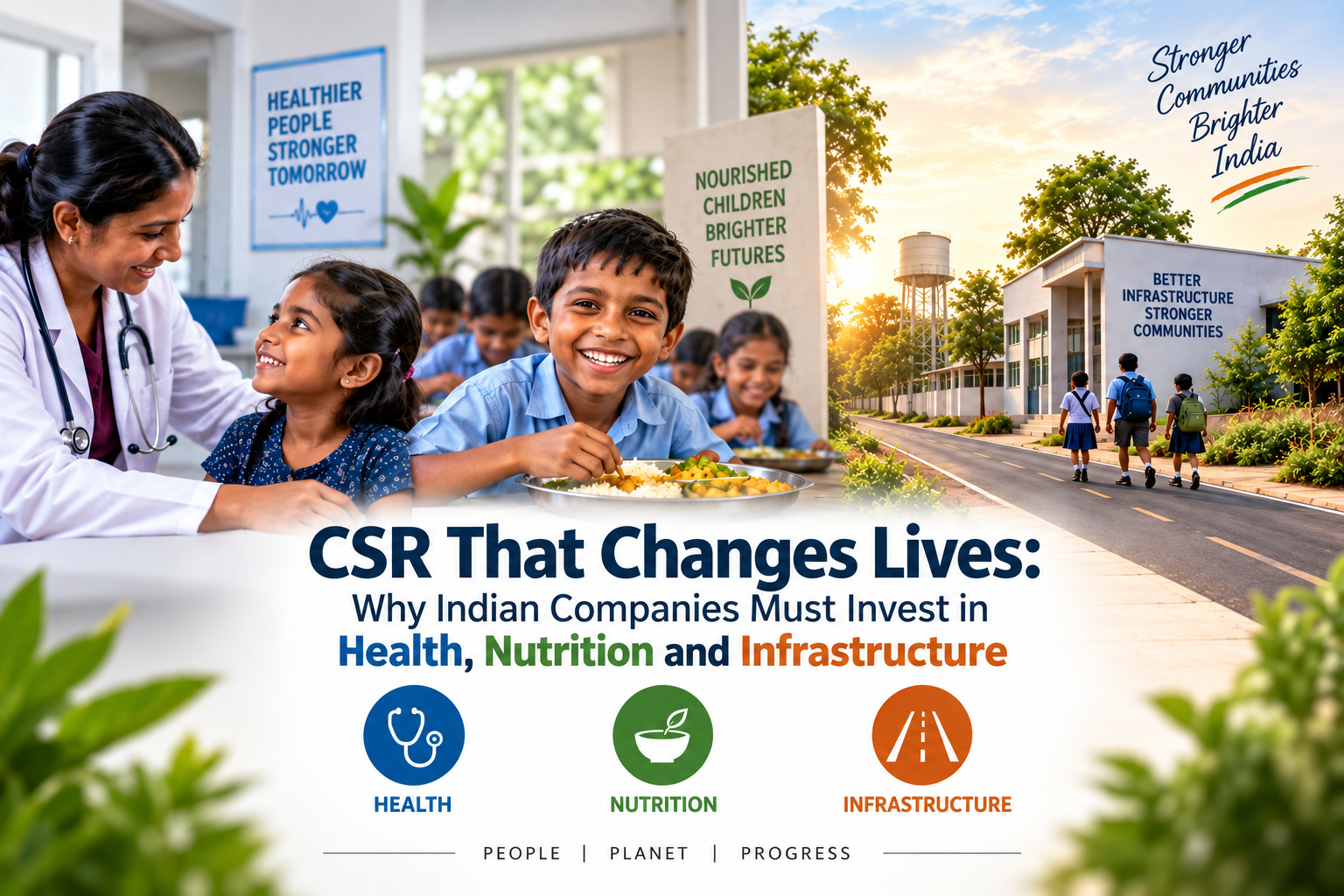
A company can build a factory in a village in a matter of months. It can construct a road, put up a school building, install a water tank or donate an ambulance and proudly announce the achievement.But what happens five years later?Is the health centre still functioning? Is the ambulance still on the road? Are children actually better nourished? Does the community have clean drinking water? Is the infrastructure being maintained? Has the project genuinely changed people’s lives?
These are the questions that should define Corporate Social Responsibility in India.
Corporate Social Responsibility, or CSR, should never become a corporate ritual where money is spent simply because the law requires it. It should be understood as an opportunity for companies to participate meaningfully in India’s social development.
India’s CSR framework already recognizes areas such as eradicating hunger and malnutrition, promoting healthcare and sanitation, providing safe drinking water, education, livelihood enhancement and rural development among eligible CSR activities under Schedule VII of the Companies Act.
The opportunity, therefore, is enormous.The question is whether companies are willing to move from CSR as expenditure to CSR as impact.
Put health at the centre
If there is one area where CSR can create lasting human value, it is health.Imagine a rural family that has to travel 40 kilometres for a basic diagnostic test. Imagine an elderly person who cannot afford regular screening for hypertension or diabetes. Imagine a pregnant woman who has difficulty reaching a functioning health facility. Imagine a child whose illness could have been prevented through vaccination, nutrition and early intervention.For these families, a health-focused CSR programme is not an annual report statistic.It can mean the difference between illness being detected early and becoming a crisis.
Companies should therefore move beyond occasional medical camps. Camps are useful, but a one-day event is rarely a healthcare system.CSR should help build continuity of care.
This could include primary healthcare centres, mobile medical units, telemedicine facilities, screening programmes, maternal and child health services, mental-health support, diagnostics, emergency transport and referral networks.
The objective should be simple: take healthcare closer to the person who needs it.
India has already seen examples of companies and public-sector enterprises using CSR for sustained healthcare interventions.
Nutrition is not charity—it is nation-building
The next major priority must be nutrition.A child who goes to school hungry cannot learn effectively. A pregnant woman with inadequate nutrition faces greater risks. A young person growing up with nutritional deficiencies may carry the consequences into adulthood.Nutrition is therefore closely connected to education, productivity, immunity, maternal health and economic development.Indian companies can contribute far more strategically here.
Instead of distributing food packets occasionally, CSR programmes can support:
- Maternal and infant nutrition
- School nutrition programmes
- Micronutrient supplementation
- Anaemia prevention and screening
- Kitchen gardens and local food production
- Nutrition education for families
- Adolescent health and nutrition
- Support for community kitchens
- Training of frontline health and nutrition workers
The most effective programmes should combine food, knowledge and local capacity.A family should not simply receive a nutritional supplement. It should understand why nutrition matters, how to prepare affordable healthy food and where to seek help when a child is undernourished.
Build infrastructure that people can actually use
Infrastructure is another area where CSR can create enormous value—but only if companies think beyond construction.A beautiful building that has no staff, electricity, equipment or maintenance is not development.
A water tank without reliable water is not water security.
A toilet without sanitation systems is not sanitation.
A health centre without doctors and medicines is not healthcare.
CSR infrastructure must therefore be designed around functionality and sustainability.
Companies should consider investing in health, senior citizens and palliative care centres, drinking-water systems, sanitation, roads connecting communities to healthcare facilities, solar power for institutions, cold-chain infrastructure, digital connectivity, school facilities and community spaces.Maintenance must be part of the original plan and lending must continue in a small way.
Measure outcomes, not photographs
CSR reports can sometimes become collections of photographs: a ribbon-cutting ceremony, a distribution event, a group of smiling children and a newly painted building.
But photographs are not impact.
Impact means asking harder questions.
Did maternal health improve?
Did anaemia decline?
How many children moved from malnutrition to healthy growth?
Did school attendance improve?
How many patients received continued treatment?
Did preventable hospital admissions decrease?
Is the infrastructure still functioning three years later?
India’s CSR framework increasingly emphasizes accountability and impact assessment. Companies meeting specified thresholds are required to undertake independent impact assessments of certain qualifying projects.
This is exactly the direction CSR needs to take.
Measure what changed—not merely what was spent.
CSR should work with government, not around it
Companies should not try to replace the government.
India already has enormous public health, nutrition, education and infrastructure programmes. The smartest CSR initiatives should strengthen these systems, fill gaps, bring innovation and improve last-mile delivery.
A company might provide diagnostic equipment to a government health facility, support training for healthcare workers, fund digital health systems or improve infrastructure while ensuring that the public system can continue operating the programme.
This creates something far more valuable than a temporary corporate project: institutional capacity.
Think in decades, not financial years
Perhaps the greatest change India needs in CSR is a change in time horizon.
Social problems rarely disappear within twelve months.
Malnutrition takes sustained intervention. Health outcomes require continuity. Infrastructure needs maintenance. Behaviour change takes time.
Companies should therefore identify a few priority communities or districts and work with them for five, ten or even fifteen years.
There is already evidence that substantial CSR resources are being deployed across India. Government data reported that companies filed CSR expenditure totaling more than ₹1.44 lakh crore over the five financial years from 2019–20 to 2023–24.
The challenge is no longer simply how much money India spends on CSR.
It is how intelligently that money is converted into human development.
The real meaning of corporate citizenship
A company is not separate from the society around it.
Its employees come from communities. Its customers live in communities. Its supply chains depend on communities. Its factories use local resources. Its success is ultimately connected to the health and prosperity of the people around it.
That is why CSR should not be treated as an obligation at the end of the balance sheet.
It should be treated as corporate citizenship.
Imagine if every major Indian company adopted a long-term district or community and committed itself to improving three things: health, nutrition and essential infrastructure.
Imagine primary healthcare that actually works, children who grow up well nourished, mothers who receive timely care, villages with reliable water, schools with functioning infrastructure and communities connected to the services they need.
That would be CSR at its best.
Not a cheque.
Not a photograph.
Not a publicity campaign.
But a sustained partnership with society.
India’s corporate sector has the capital, expertise, technology and management capability to make an extraordinary contribution to national development.
The opportunity now is to use those strengths where they matter most.
The ultimate test of CSR should be simple: when the company leaves, is the community stronger than it was before the company arrived?
If the answer is yes, CSR has done its job.If the answer is no, perhaps we need to rethink what we mean by corporate social responsibility.