
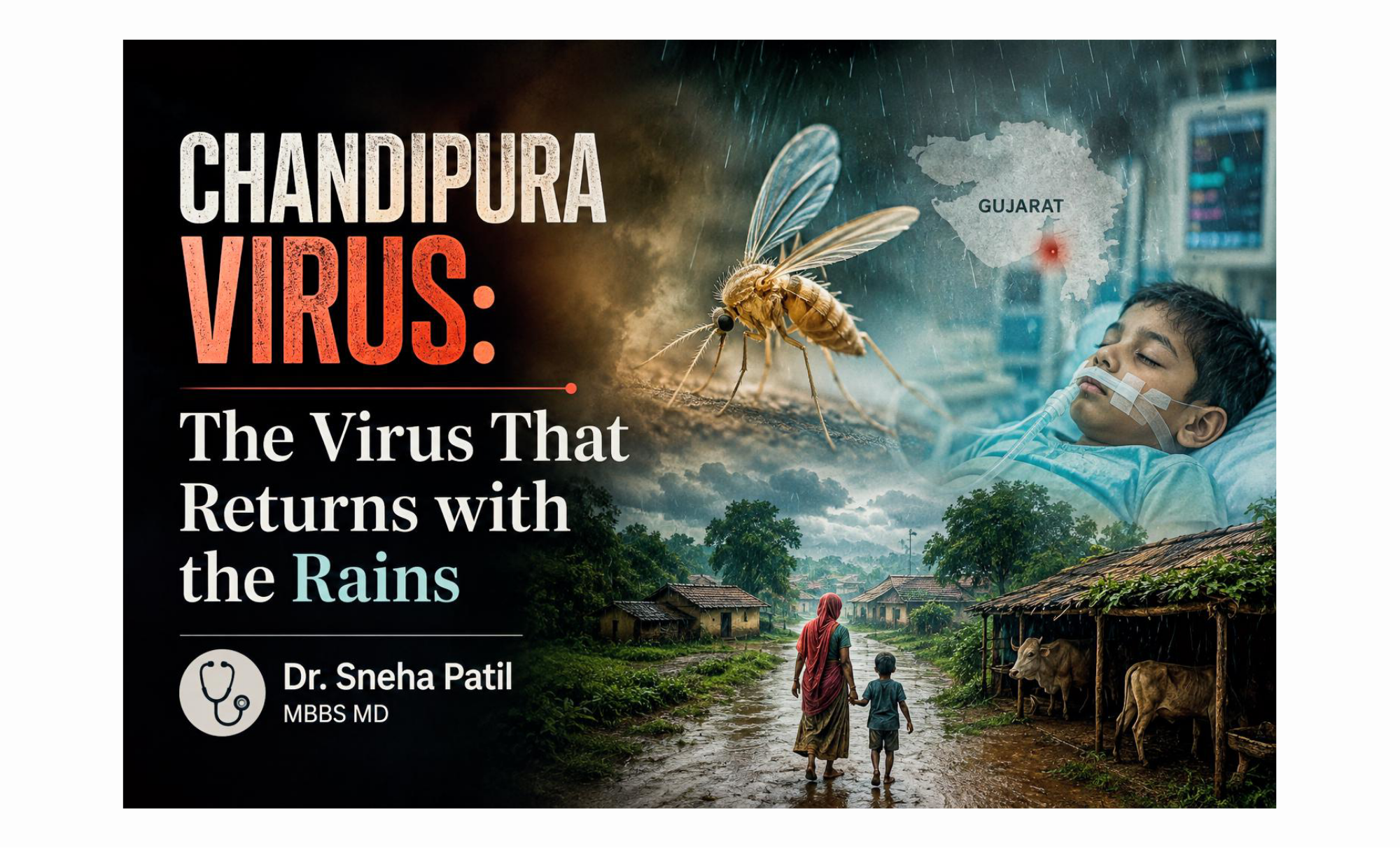
There are two stories to every outbreak. One is in the surveillance reports, laboratory confirmations, and epidemiologic curves. The other is set in hospital corridors, where anxious parents wait outside intensive care units, hoping that a fever that began only hours ago will not become a farewell. The recent outbreak of Chandipura virus in Gujarat is both.
For most of us, fever is an irritant, especially during the monsoon. The rainy season ushers in a familiar parade of viral illnesses, most of which resolve with rest, fluids and time. Parents learn to watch, doctors learn to reassure, and life goes on in communities. Chandipura virus hides behind the mask of a common childhood disease, before a far more devastating truth is revealed.
This little-known virus has again come under the national spotlight with the monsoon outbreak that has played out across parts of Gujarat. Hospitals have admitted children with acute encephalitis, laboratory investigations have been ramped up and multidisciplinary teams from the state and central governments have been dispatched to ascertain the cause of the illness and contain further spread.
The outbreak has already demonstrated something that public health experts have known for decades, even as the scientific work is still being done. Infections emerge in silence, exploit familiar vulnerabilities and leave behind difficult questions when the immediate crisis has passed.
The first of those questions is an easy one.
Why do we act surprised?
The Chandipura virus is not new. It was isolated from the blood of a patient in Chandipura village in Maharashtra by scientists at the ICMR-National Institute of Virology in 1965. Since then, it has popped up again and again in western and central India, including in Maharashtra, Gujarat, Andhra Pradesh and Telangana.
And every few years, another outbreak.
Every few years children get very sick.
Every few years the country remembers a virus it had almost forgotten.
Pathogenic organisms have always existed in nature. Many outbreaks, unfortunately, continue to expose the vulnerabilities that we already know about. This is a situation where a rare virus can still kill young people due to late diagnosis of critical conditions, lack of availability of specialised medical care, environmental factors facilitating disease spread and low publicknowledge.
The story of Chandipura virus is thus much larger than virology.
It’s a story of the intersection of people, place and environment.
The monsoon changes India in amazing ways. Rivers flow, crops grow, and landscapes that have been dry for months are revived. But the same rains also change the ecology of infectious disease. Increased humidity, lush vegetation and changing insect populations create opportunities for pathogens that are largely invisible for the rest of the year.
Mosquitoes are the main topic of conversation regarding monsoon diseases. We automatically think of dengue, malaria or chikungunya. The Chandipura virus is subtler.The evidence we have right now points to the disease being spread mainly by female phlebotomine sandflies, which are tiny insects that thrive in warm, humid conditions and are often unnoticed. They nest in crevices of mud walls, animal shelters, heaps of organic debris and shaded vegetation.
Unlike mosquitoes, they rarely attract community concern, although the ecological conditions that sustain them are deeply embedded in rural life. That helps explain why outbreaks have historically affected rural and tribal communities more than densely populated cities. The answer is not in geography but in the reality of the daily life.
Many families live in close proximity to livestock, rely on agriculture for their livelihoods and spend long hours outdoors during the very season when vector activity is at its peak. Healthcare facilities may be far away, transport difficult and specialist paediatric services even further away. When a child gets a fever, families often do what generations of parents have always done. They are waiting. They hope the sickness will clear up by itself.
Most of the time, that instinct is right.
The Chandipura virus is frightening because it punishes that instinct.
The first symptoms are almost indistinguishable from those of a number of viral illnesses occurring in the rainy season.
Fever, vomiting, irritability and weakness do not usually suggest impending brain involvement. But in susceptible children, the disease can progress at an alarming rate.
Seizures may develop within hours.
Deterioration of consciousness occurs and intensive care is a race against time.
Doctors are left to treat a disease for which there is no specific antiviral therapy and no licensed vaccine. Their greatest advantage is often not a new medicine but early diagnosis and rapid supportive care before irreversible neurological damage occurs.
That is why each and every outbreak carries lessons that go far beyond the patients being admitted to hospital. Each one asks whether the warning signs were seen early enough, whether communities knew when to seek urgent medical help, whether surveillance systems linked widely scattered cases soon enough and whether laboratories had the capacity to identify an unusual pathogen before uncertainty turned to panic.
Outbreaks are, in many ways, the unscheduled audits of the health system.
They test everything that normally runs in the background.
And they almost always show that the real battle against infectious disease begins long before the first ambulance arrives.
If there’s one thing the Chandipura virus teaches us, it’s humility.
Despite the amazing advances in medicine, there are infections that outrun our ability to treat them. Even as we have decoded genomes, developed vaccines at an accelerated pace, and employed artificial intelligence to help diagnose, a small virus first identified in India over 60 years ago continues to remind us that nature still has the upper hand.
What makes the Chandipura virus so unsettling is not that it is rare, but that it is unpredictable. Many infections are mild or may even be unnoticed. In others, particularly in young children, they are devastating. Scientists still don’t know why.
Does it matter how much virus enters your body?
Is it the child’s immune system?
Are there genetic differences that make us vulnerable?
Or is it environmental factors that determine how severe disease is?
There are answers. But not enough of them.
Each outbreak teaches us more but also shows how little we know.
This is a typical feature of emerging infectious diseases. Science rarely works in absolutes. It plays one piece of evidence at a time, paying close attention to detail.
Clinicians save lives, while epidemiologists trace the spread of disease through the affected villages. Virologists analyse samples from patients, entomologists investigate insect populations, public health teams search for trends that might explain why one community is affected but another, just a few kilometres away, is spared.
Outbreak investigations are often compared to detective work, but perhaps they are more like trying to put together a jigsaw puzzle with some of the pieces missing.
The virus is just one piece of a larger puzzle.
Another is the environment.
For years, public health officials have noted that climate and ecology have become increasingly important factors in the spread of infectious diseases. Changing rainfall patterns, rising temperatures, deforestation and rapid land use changes are altering the habitats of insects that transmit disease.
These changes don’t make new viruses overnight. Instead they subtly alter the opportunities for viruses that have been around for decades.
The relationship is well exemplified by the Chandipura virus. Outbreaks are almost always coincident with the southwest monsoon. Not because the rain creates the virus, but because it creates conditions that favour its vector. Humidity – humidity is higher, sandflies survive longer. Vegetation and organic matter – suitable places for resting. People living close to forests, farms and livestock will be more exposed to these insects than people living in densely built-up urban neighbourhoods.
The monsoon, therefore, is both a boon and a biological opportunity.
It feeds crops, replenishes reservoirs and supports millions of livelihoods.
At the same time, it is silently reshaping the landscape in ways that allow several infectious diseases to thrive. This is why public health professionals greet the arrival of the rains with a mixture of relief and apprehension.
The same season that nurtures life, also puts resilience in health systems to the test.
But it would be wrong to regard the Chandipura virus as just an environmental problem.
Ecology determines where the virus is circulating, but society determines how badly it hurts people.
Children from far-flung tribal villages usually reach healthcare facilities later than those in urban centres. The roads could be tricky to drive on with heavy rain. Transportation is costly. That assumption is right most of the time and parents may just ignore fever as another seasonal bug.
Primary health centres can stabilise critically ill children but specialist neurological care is usually only available in district or tertiary hospitals.
Any delay, however justified, decreases the window in which supportive treatment can be effective.
This is where public health becomes a tool for equity.
A surveillance system is more than a database of numbers. This is a sort of early warning system that detects unusual patterns before they turn tragic. But a laboratory is not just a place for virus identification. It gives certainty when uncertainty can cost lives. An accredited social health activist, and visiting household, an auxiliary nurse midwife identifying a child needing urgent referral or a district surveillance officer noticing an unexpected cluster of encephalitis cases may never get any public recognition. But often it is these people who decide whether an outbreak remains local or spreads unnoticed.
Effective public health rarely announces its presence.
Its greatest achievements are often unseen because they prevent crises that never occur.
The response to the Gujarat outbreak must therefore be put into a larger perspective. Rapid mobilisation of surveillance teams, laboratory scientists, clinicians and vector control experts is important not only to contain the current outbreak but also to strengthen systems that will confront future ones. Every investigation adds to our knowledge. Each report of an outbreak goes into a larger body of knowledge that guides the next response.
The challenge is in making sure these lessons last long after the monsoon is over.
The reflex when outbreaks happen is often to ask whether they could have been prevented. That’s a fair question, but not always the right one. Infectious diseases have always come along with humanity and no country, however scientific or economic advanced, can stamp out all emerging pathogens.
The more relevant question is whether we can spot the threats soon enough, react fast enough and learn enough to reduce their impact the next time.
That is where Gujarat’s experience deserves to be more than a mere chapter in disease surveillance reports.
Every outbreak leaves knowledge behind. It shows where surveillance worked and where it didn’t. It reveals whether labs were ready to rapidly identify an unknown pathogen, whether health workers on the front lines spotted warning signs in time, and whether families could access appropriate care before illness became irreversible. The true legacy of any public health emergency is these lessons, often lost in the daily case counts and media headlines.
Increasingly, the lines between human health, animal health and the environment are blurring. As forests give way to settlements, as farming methods evolve and climate becomes more unpredictable, so too is the ecology of infectious diseases. The next outbreak may not be the same as the last, and the pathogen causing it may not even be something we recognise today.
More than responding to individual diseases will be needed to prepare for that future. That means investing in systems that are robust enough to catch the unexpected.
India has made tremendous progress in strengthening disease surveillance, expanding laboratory networks and building rapid response teams over the past two decades. Institutions such as the Integrated Disease Surveillance Programme, ICMR laboratories and state public health departments have changed the country’s ability to investigate outbreaks that may have been missed earlier. The response to the current outbreak is a reflection of that progress. But preparedness is not a destination. It is a constant process of adaptation to a world in which microbes, vectors and ecosystems are in a state of flux.
The responsibility is not only of governments. Public health is held up by innumerable unnoticed acts. A parent taking a child with a fever and abnormal drowsiness to a doctor. An ASHA worker observes a peculiar cluster of diseases in nearby villages. a clinician who reports a suspected case, rather than diagnosing it as yet another seasonal viral infection. Laboratory scientist who identifies an unexpected pathogen. None of these steps are complex in themselves. Together they create the invisible network that protects communities long before an outbreak makes national headlines.
Perhaps this is why the Chandipura virus deserves our attention even as the immediate crisis fades. It is rare among infectious diseases and is not likely to be the next global pandemic. Its importance is not there. Public health is often tested in underreported areas with obscure diseases, often impacting marginalised communities.
In a world obsessed with the next great health emergency, we are seduced into measuring preparedness by how quickly we respond after hospitals start to fill. True readiness, however, is quieter than this.
The surveillance officer sees something odd before anyone else can.
Before the facts get ahead of the rumours, the lab diagnosis. They know in the district hospital that this child needs to be referred urgently. There is an understanding in the community, that on rare occasions an ordinary fever can be the beginning of something far more serious.
The Gujarat epidemic will have its course. The rains will pass, surveillance teams will move on to other duties and new concerns will take their place in the headlines. That’s the rhythm of public health. But viruses don't follow the news cycle. They remain in nature, waiting patiently for the ecological conditions that favour their return.
It remains to be seen whether the next monsoon will bring with it another Chandipura outbreak. Today we can answer the question whether it surprises us.
The true legacy of every outbreak is not the number of cases it reports but the lessons it leaves behind.
If Gujarat strengthens our resolve to invest in surveillance, support scientific research, protect vulnerable communities and identify emerging threats before they become crises, then this outbreak will have accomplished something beyond containment. It will have reminded us that the best defence against new infections is not fear but preparedness based on science, vigilance and collective responsibility.
That’s the lesson to remember long after the rains have stopped.